


“Have you ever worked with anyone as far gone as I am?”
She seemed to grow even smaller as she asked the question. To shrink even further into herself. It’s not a good sign when someone has given up before they begin.
Every call this client would ask that same question. She was completely sure she was worse off than anyone else.
She wanted guarantees before doing the work. She wanted to talk about how bad it was before doing anything. This is a lot like being caught between a rock and a hard place.
That guarantee? It comes from doing the work, not before it.
The Pattern: Smart People, Sophisticated Stalling
We create sophisticated and seemingly logical resistance patterns. Personally, I’ve done it myself. Sometimes I still catch myself leaning toward it.
Instead of diving right into my business and enthusiastically helping people who needed it there was constantly one more course “I needed” and “then I’ll be ready.”
I’m rolling my eyes at myself as I type this. Shaking my head too. It’s all so clear now.
The stall tactics.
Another one is:
“I don’t have time now, it’s just too busy for me to commit.”
Which won’t change. You make time for the things that matter, time doesn’t rearrange itself for you and suddenly offer an opening with a neon sign that says “Now Is The Time.”
Wouldn’t that be nice?
That’s our brain being logical and rationalizing with clever excuses because your nervous system has slammed on the brakes. Your unconscious mind communicates through your body to let you know that no action is the best action right now.
What if this is just another way the unconscious mind has us myopically focusing on what we don’t want?
The closer you look the more it seems like no other options are possible and the list of things that you don’t want is infinite.
You cannot get what you want by focusing on what you don’t want.
That is like planting radish seeds and wondering when strawberries will grow. (Spoiler: they won’t, you’ll get some lovely radishes though.)
All these questions and excuses? The need for guarantees?
It’s really just M.U.D. showing up - Misguided Unconscious Beliefs.
I tried to change before and it didn’t work. I’m worse off now.
If I get better, people will demand more from me. And I don’t have enough time as it is.
What if I fail at this new business? I’ll prove I’m just not good enough just like they said.
The quality of our life is determined by the quality of the stories we’re telling ourselves.
And when you step outside of your story and survive you create a powerful prediction error that causes the unconscious mind to update its expectations.
Why You Can’t Think Your Way Out of This
So your nervous system is predicting that perfection keeps you safe. That’s why you reach for another course.
You want a guarantee; you stall by trying to logically find the solutions.
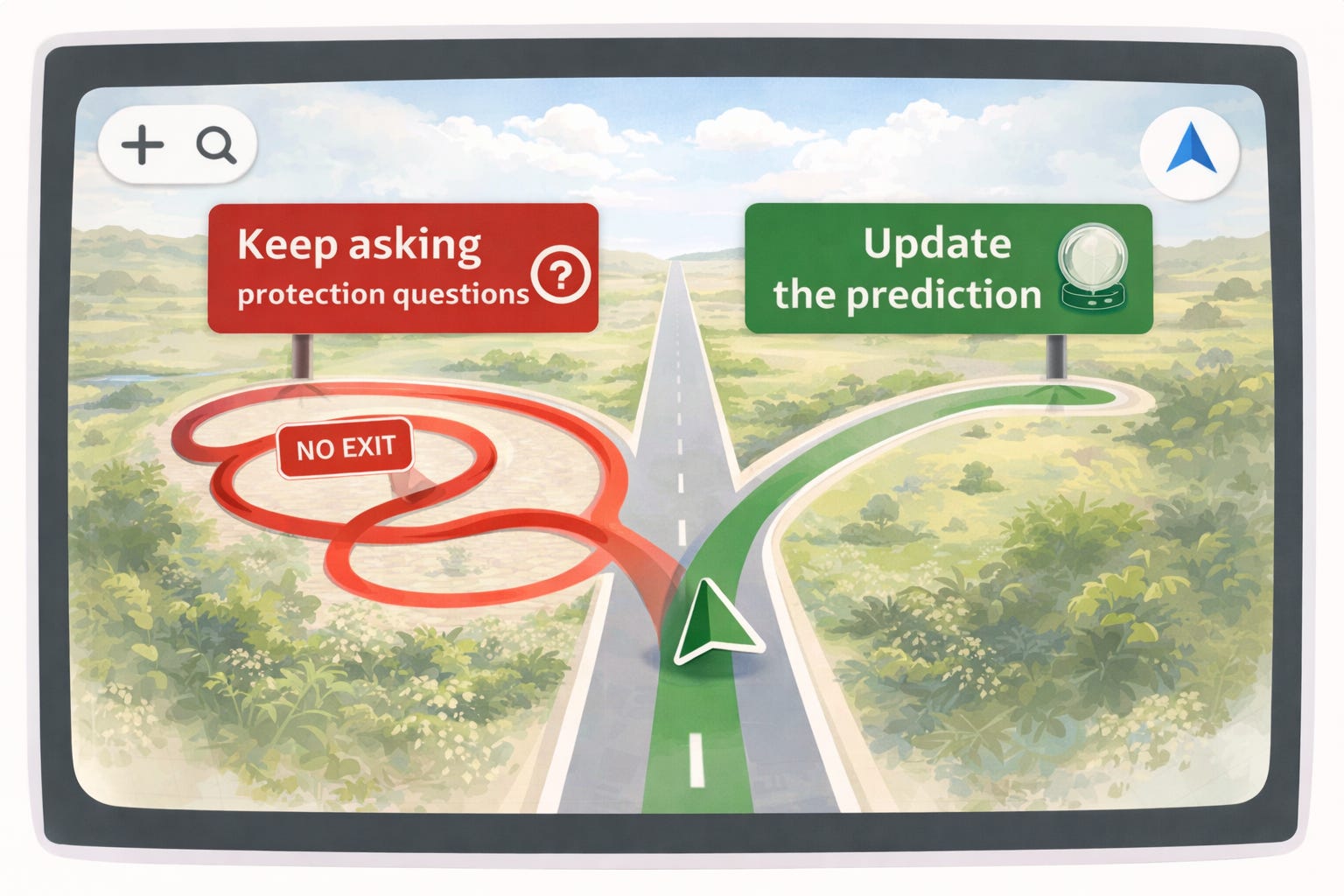
What needs to happen, and what will help you change even faster, is to create a prediction error. To actually do something different, take a step outside of that nervous system prediction that aims to keep you safe (but is actually keeping you stuck).
The world doesn’t collapse. No one points at you and says you’re not ready, you’re not doing enough.
It took me a while to get there in my business: to launch programs or courses without knowing THE ONE RIGHT WAY in advance, seeing all the steps laid out from here until infinity.
I adopted the phrase “start ugly” and I do. The prediction error that I created was “It’s not perfect and ALL IS WELL.”
What I did was take action, adapt, learn, and grow stronger and more confident for it. (And you can do that too.)
Trying to plan it all perfectly before you move forward is part of the trap. Each time you give in to this trance it convinces you that disaster has been averted, further confirming to need to do this.
The only way to move beyond that story and belief is to take a small step that is in opposition to it, to use what you’ve learned and apply it.
To take the client, do the post, offer the program without this endless list of ‘it needs to be perfect’ or ‘I need just one more course.’
This is how you create a prediction error and update the belief system.
The Modality Hopping Trap
This is embarrassing to admit, but I used to start a book and every time there was an exercise to do, I would skip over it.
I told myself, “I don’t have time for this now” (lie) or “I’ll come back to this later” (bigger lie).
Sometimes I’d feel uncomfortable and distract myself.
Next time I picked up the book I would move on.
I read book after book, never actually doing any of the exercises. I could brag of reading all these books and quote bits from my collection of “shelf knowledge.”
And it was all useless because I applied nothing in the real world.
One day, I stopped skipping the exercises and I started doing the work. Answering the questions.
I learned I don’t need to know more, read more, listen more to answer a question about me. I’m already the expert on me, anyway.
Many clients have come to me doing the same thing. Except instead of books it is modalities. They will say they “know” this modality, but they haven’t applied it, or done the work for very long or with any degree of consistency. A lot like I had done with my earlier reading habit.
Do you know anyone like that? They know 15 different change work modalities, they are still stuck today, and are even now looking for the next modality?
What Actually Has to Happen First
Cassie wanted more connection and belonging in her life.
She felt like she was in the dark while everyone else was in the light.
Her first thoughts as we began working together seemed very logical:
“I just need to understand what’s really happening.”
“I want to make sure I’m not overreacting.”
“Before I change anything, I need the full picture.”
Perfectly reasonable, right?
But it was camouflage. A smoke screen for an unwritten rule Cassie had been living under:
“If I create connection, that’s schmoozing.”
And schmoozing was not allowed. It went against the family code.
The Lightbulb Moment
Back in the present, she kept saying:
“I just don’t have the right words.”
It sounded practical. Social. Harmless.
But when we slowed it down, she realized:
If I say the wrong thing, I will be excluded.
If I initiate, I might be seen as manipulative.
If I step forward, I could lose belonging.
Her entire “I need to think this through” stance wasn’t caution, it was how she survived based on unconscious predictions.
Recognizing the pattern is an important prelude to the 3Rs…
R1: Rewrite the Memory
First, we had to rewrite the story. Not the facts, the meaning she’d attached to them.
The family code that said “initiating connection = schmoozing = morally wrong” wasn’t objective truth. It was one interpretation, a perception formed at a time when young Cassie was trying to make sense of complex family dynamics.
We revisited those early memories where she’d learned this rule. We updated what they meant. Connection wasn’t manipulation. Reaching out wasn’t scheming. Those were her family’s fears and projections, not an unchangeable law of the universe.
This shifted her perception. Suddenly “I don’t have the right words” wasn’t a skill deficit, it was a protection mechanism.
R2: Rewire the Emotional Pattern
But knowing this intellectually wasn’t enough. Her body still had the instant response: initiate = danger.
That freeze when someone new walked into a room. The urge to wait for others to speak first. The physical contraction when she thought about texting someone without being texted first.
So we created a vivid mental rehearsal. She imagined stepping forward. Speaking first. Hugging someone hello. Smiling openly.
In her mind, she practiced until her nervous system registered:
“Life is one big group hug.”
A sentence that did not exist in her system before.
The world didn’t end in her imagination. No one shamed her. No moral collapse followed. Her body softened.
This was the prediction error that allowed a lifetime of belief and caution to collapse and reassemble.
R3: Retrain the Nervous System
Then came the real-time practice. Small steps. Baby steps.
Cassie began:
Texting without waiting to be texted first
Expressing appreciation without rehearsing for hours
Making and holding eye contact
Initiating small talk
Each time she did this, her nervous system got new data:
“I initiated. I’m still safe. I still belong.”
The permission-seeking questions faded:
“Am I doing this right?”
“Do you think I should...?”
“What if they think I’m...?”
She stopped needing the full plan. The practical problems she thought she had to solve before moving? They dissolved.
Because once her nervous system stopped defending against predicted exclusion, connection became natural.
This is the same process I use on myself.
Every time I post on Substack without the “perfect formula,” I’m creating a prediction error.
My nervous system expected catastrophe: silence, judgment, proof that I’m not ready.
Instead? Engagement. Connection. People saying “this helped me.”
Small steps. Real-time updates. A nervous system that learns: “I can be visible and still be safe.”
The Question That Actually Moves You Forward
So instead of asking, “Have you ever worked with anyone as bad off as I am?” you might ask, “What catastrophe am I trying to prevent by staying stuck and not trying this new thing?”
And your mind will answer. It will let you know where that came from. Maybe even how old you were when you came up with that decision; the M.U.D. - misguided unconscious decisions.
From there you can move forward with your eyes open because you’ve broken one of those trances.
Your Invitation
In The Permission Experiment, we work through all three Rs:
We rewrite your stories through memory reconsolidation and story circles.
We rewire your emotional holding patterns through breath enhanced emotional processing.
We retrain your nervous system through compound coaching.
When you stop asking protection questions and start updating predictions, the practical answers you thought you needed become obvious. The path forward becomes clear.
The next cohort begins in April.
Get on the waitlist here: The Permission Experiment
Nicola - Great piece! I like how you look at the way practical questions can function as a type of protection rather than a step toward doing something different. The way you frame those questions as attempts to prevent a predicted outcome makes a lot of sense. It helps clarify why insight and preparation can go on for so long without anything actually changing for us.
What’s useful is your focus on creating a contradiction to that prediction. When we take small steps and find out that the feared outcome doesn’t occur, when it doesn't, it often begins to update what we expect in a good way moving foward.
In my case, I felt crippled because I was hooked on irrational fears, just like Cassie was.
One fear was more prominent than the rest—the fear of success.
"If I actually get better, then I'll have to do this, be that, keep doing that, become responsible for things I don't want to...So, I'd rather stay a mess."
I'm not proud of this but this was my stare of mind several months ago.
I was rationalizing staying stuck and shooting down any attempt at getting out of "stuckness"—even when my body was begging me to move.
It was only when I started listening to my body, I was able question my wrong predictions.
Thanks for this, N. 💙